

Digital Transformation Lessons from Top Construction Contractors in Texas
Quick Answer
Digital transformation in construction is not about adopting more software—it is about improving how information moves across projects. Top contractors modernize operations by standardizing workflows, centralizing documentation, and digitizing approvals. These changes reduce delays, improve visibility, and help teams scale without increasing administrative complexity.
Key Takeaways
- Digital transformation is primarily about workflows, not tools.
- Leading contractors focus on standardizing processes across all projects.
- Centralized document systems improve visibility and reduce risk.
- Mobile and digital approvals connect field and office teams.
- Successful transformation enables scaling without proportional administrative growth.
Construction Digital Transformation Is Not What Most People Think
When construction leaders hear “digital transformation,” the conversation often turns to software platforms, apps, dashboards, or new systems.
But top-performing contractors think differently.
They don’t start with tools.
They start with workflows.
Because in construction, the real problem is rarely the lack of technology—it is the lack of consistent, connected processes across projects, teams, and job sites.
For many Texas contractors, transformation is not about replacing everything at once. It is about reducing friction in how work already happens.
What Digital Transformation Actually Means in Construction
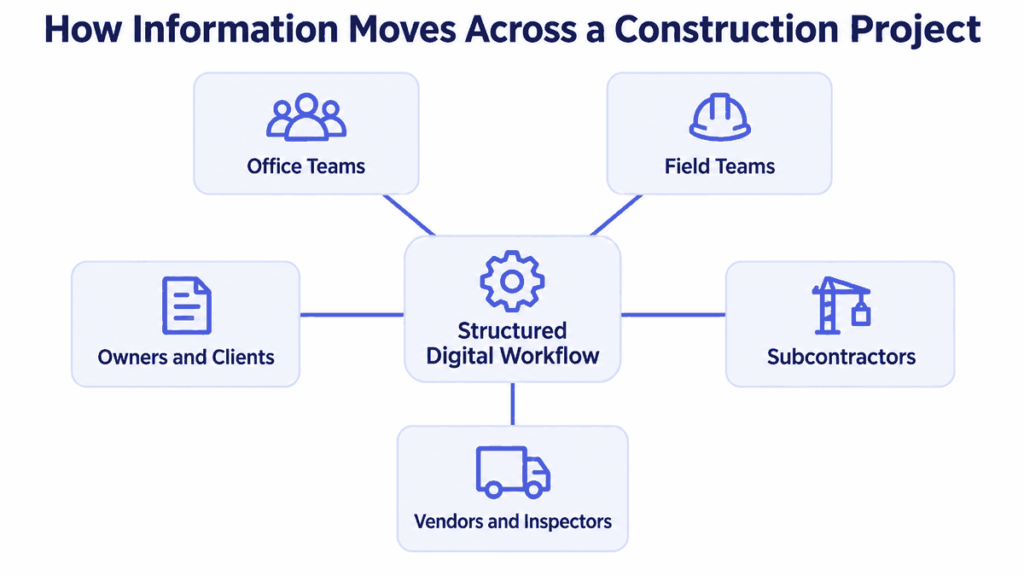
At its core, construction digital transformation means improving how information flows between:
- Office teams
- Field teams
- Subcontractors
- Owners and clients
- Vendors and inspectors
It focuses on eliminating manual steps in processes such as:
- Document approvals
- Change orders
- Subcontractor onboarding
- Compliance documentation
- RFIs and inspections
- Project closeouts
Instead of relying on disconnected systems, paper files, and email chains, top contractors build structured digital workflows that connect every part of the project lifecycle.
Lesson 1: Standardization Comes Before Automation
One of the biggest mistakes contractors make is trying to automate inconsistent processes.
Top-performing construction companies first standardize:
- Approval workflows
- Document templates
- Naming conventions
- Routing structures
- Compliance requirements
Without standardization, digital tools simply replicate inefficiencies faster.
Standardization ensures that every project follows the same predictable structure, regardless of location or team.
Lesson 2: Visibility Is More Valuable Than Speed Alone
While speed is important, top contractors prioritize visibility.
They want to know:
- Where every document is in the approval process
- Who is responsible for the next action
- What is delayed and why
- Which projects are at risk of falling behind
Visibility reduces uncertainty across projects.
It allows operations leaders to intervene early instead of reacting after delays occur.
This is especially important for mid-market contractors managing multiple projects across Texas cities like Houston, Dallas, Austin, and San Antonio.

Lesson 3: Field and Office Must Work on the Same System
One of the biggest disconnects in construction happens between the field and the office.
Field teams work in real-time conditions.
Office teams manage documentation and approvals.
When these groups operate in separate systems, delays are inevitable.
Top contractors solve this by enabling:
- Mobile approvals for field teams
- Real-time document updates
- Centralized access to project information
- Instant communication of approvals and changes
This ensures that decisions made in the field are immediately reflected in project documentation.
Lesson 4: Paper Is Not Just Slow—It Is Fragmented
Many contractors underestimate the impact of paper-based workflows.
Paper creates fragmentation:
- Documents exist in multiple versions
- Approvals are difficult to track
- Records are stored in multiple locations
- Information is not searchable
Top contractors eliminate fragmentation by digitizing all approval-related workflows.
This creates a single source of truth for every project document.
Lesson 5: Scaling Requires Process Discipline, Not More Staff
As construction companies grow, administrative workload grows with them—unless workflows are optimized.
Top contractors avoid scaling inefficiencies by:
- Automating repetitive approvals
- Reducing manual document handling
- Centralizing compliance records
- Standardizing onboarding processes
- Eliminating redundant approval steps
This allows them to take on more projects without increasing administrative overhead at the same rate.
Why This Matters for Texas Contractors
Texas remains one of the most active construction markets in the United States, with growth across commercial development, energy infrastructure, manufacturing, and large-scale residential projects.
This growth creates opportunity—but also complexity.
Mid-market contractors often find themselves managing:
- More subcontractors
- More simultaneous projects
- More documentation
- More compliance requirements
- More approvals across distributed teams
Without structured workflows, operational complexity quickly becomes a constraint on growth.
Digital transformation is how leading contractors maintain control while scaling operations.
What Mature Digital Construction Operations Look Like
Top-performing contractors share common characteristics in how they manage workflows:
| Traditional Operations | Digitally Mature Operations |
| Email-based approvals | Automated approval workflows |
| Paper documentation | Centralized digital records |
| Manual tracking | Real-time visibility |
| Reactive management | Proactive decision-making |
| Fragmented systems | Integrated workflows |
The difference is not just efficiency—it is operational clarity.
How DottedSign Supports Construction Digital Transformation
Digital transformation requires more than storing documents.
It requires structured workflows that ensure documents move through the right approval paths at the right time.
DottedSign helps construction companies:
- Standardize approval workflows across all projects
- Route documents automatically to required stakeholders
- Collect secure electronic signatures from any device
- Track document status in real time
- Maintain centralized, searchable records
- Support mobile approvals for field teams
- Maintain audit trail certification for every document
Instead of managing documents manually, teams operate within a structured system that ensures consistency across every project.
For contractors using ERP systems, construction management platforms, or internal tools, DottedSign’s API enables embedded eSignature workflows directly within existing systems—supporting transformation without disrupting operations.
Frequently Asked Questions
Digital transformation in construction refers to improving how information and workflows move across projects by replacing manual processes with digital systems for approvals, documentation, and communication.
It improves visibility, reduces delays, increases operational efficiency, and enables contractors to scale without proportionally increasing administrative workload.
Most companies start with change orders, approvals, subcontractor onboarding, compliance documentation, and project closeout workflows.
No. Many contractors improve efficiency by layering digital workflows on top of existing project management systems rather than replacing them entirely.
Transformation Is Not a Project. It Is a Discipline.
The most successful construction companies do not treat digital transformation as a one-time initiative.
They treat it as an ongoing discipline of improving how work flows across teams, projects, and systems.
By focusing on standardization, visibility, and workflow consistency, Texas contractors can build operations that scale more efficiently and adapt more easily to growing project complexity.
Ready to Modernize Your Construction Workflows?
DottedSign helps Texas construction teams standardize and digitize document workflows across every stage of a project. From approvals and onboarding to compliance and project closeouts, teams gain greater visibility, faster decision-making, and more consistent operations across all job sites.