Measuring the Cost of Manual Documentation
Most businesses understand that paperwork creates inconvenience.
Printing documents takes time.
Searching for files is frustrating.
Following up on approvals is inefficient.
But the true cost of manual documentation goes far beyond paper, printing, or administrative effort.
For growing organizations, documentation affects how quickly work gets completed, how easily teams collaborate, and how confidently leaders can make decisions.
A delayed approval can slow down a project.
A missing document can create compliance risk.
A manual process can prevent teams from scaling efficiently.
The challenge is that these costs are often hidden inside everyday operations.
Teams find ways to work around them, but the impact continues to accumulate.
For construction companies, energy providers, utilities, and field service organizations, understanding the cost of manual documentation is the first step toward building more efficient workflows.
Manual Documentation Creates More Than Administrative Work
When people think about manual documentation, they often think about physical paperwork.
However, many modern organizations still experience manual documentation challenges even without traditional filing cabinets.
A document sent through email.
A spreadsheet used to track approvals.
A PDF that requires multiple follow-ups.
A form that needs to be manually uploaded and organized.
These processes may be digital, but they are still manual.
The real issue is not whether a document exists electronically.
The issue is whether the process surrounding that document is structured, visible, and efficient.
The Hidden Costs of Manual Documentation
The impact of manual documentation usually appears across several areas of the business.
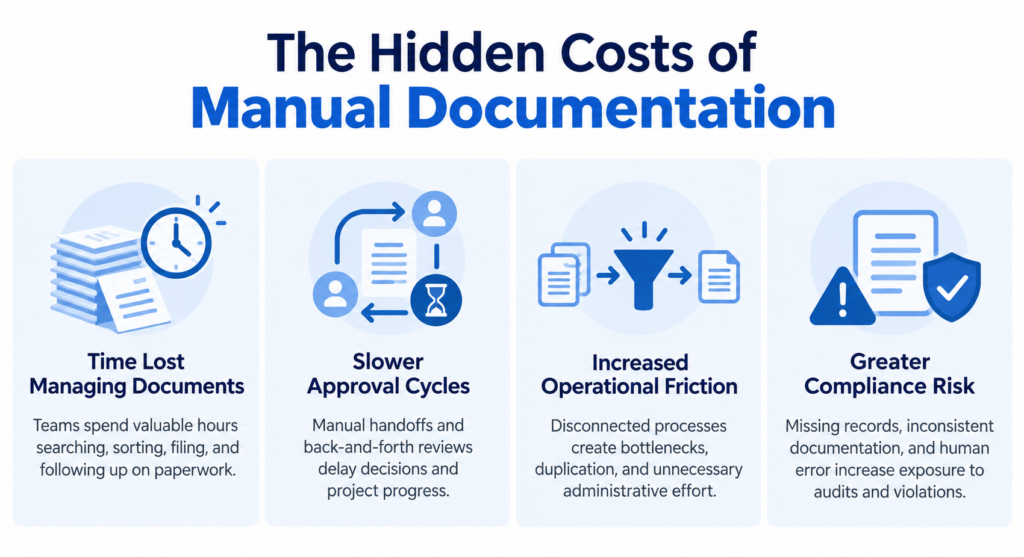
Time Lost Managing Documents
One of the biggest costs is employee time.
Project managers, supervisors, administrators, and operations teams often spend significant portions of their day managing documentation.
They search for missing files.
Send approval reminders.
Confirm document status.
Move information between systems.
Individually, these tasks may only take a few minutes.
Across hundreds or thousands of documents, the time adds up quickly.
For operational teams, administrative work can quietly take time away from higher-value activities like managing projects, serving customers, and improving processes.
Slower Approval Cycles
Many business decisions depend on documentation moving through multiple stakeholders.
A change order may require approval from a project manager, customer, and operations leader.
A service report may need review before billing can begin.
A safety document may require confirmation before work continues.
When these processes rely on manual communication, delays become common.
Documents wait in inboxes.
Approvers miss requests.
Teams follow up repeatedly.
The result is slower decision-making across the organization.
Increased Operational Friction
Manual documentation creates friction between teams.
This is especially noticeable in industries where office teams and field teams must work together.
A technician completes a service report in the field.
A supervisor reviews the document.
An operations team processes the information.
A customer provides final approval.
Every handoff creates another opportunity for delay or miscommunication.
For distributed teams, documentation needs to move as quickly as the work itself.
Greater Compliance Risk
Documentation is often tied directly to compliance requirements.
Businesses need accurate records for:
- Safety procedures
- Inspections
- Customer approvals
- Vendor agreements
- Service completion
- Project closeouts
When documents are manually managed, organizations face greater risk of:
- Missing records
- Incorrect versions
- Incomplete approvals
- Difficulty locating historical documentation
A structured workflow creates stronger consistency by ensuring documents follow the correct process from start to finish.

Why Manual Documentation Becomes a Bigger Problem as Companies Grow
Many businesses do not experience serious documentation challenges when they are small.
A small team can often manage approvals through conversations, emails, and shared folders.
But growth changes the equation.
More employees create more communication paths.
More projects create more documentation.
More locations create more coordination challenges.
This is especially true for Texas-based operational industries.
Construction firms managing multiple job sites.
Energy service providers coordinating field crews.
Utility teams maintain infrastructure across large regions.
Industrial service companies working with multiple customers and contractors.
As these organizations expand, informal documentation processes become increasingly difficult to maintain.
How to Calculate the Cost of Manual Documentation
Organizations can begin evaluating documentation costs by looking beyond obvious expenses.
| Cost Area | Questions to Ask |
| Employee Time | How many hours each week are spent tracking approvals, searching for documents, sending reminders, and organizing completed paperwork? |
| Approval Delays | How often does work wait because documentation has not been completed — projects waiting for approvals, technicians waiting for customer signoff, or contractors waiting for authorization? |
| Administrative Overhead | How many employees are involved in managing documentation processes, and could those resources be focused on higher-value activities? |
| Compliance Impact | What is the cost of missing or incomplete records during audits, inspections, or customer reviews? |
The Shift From Manual Documentation to Digital Workflows
The solution is not simply replacing paper with electronic signatures.
A digital signature alone does not solve workflow problems.
Organizations need systems that improve how documents move.
Workflow automation helps create structured processes where documents are automatically routed, tracked, and completed.
Instead of asking:
“Where is this document?”
Teams can see:
“Who has it?”
“What happens next?”
“When will it be completed?”
This visibility helps businesses reduce delays while improving accountability.
How DottedSign Helps Reduce Documentation Costs
DottedSign combines eSignature with automated routing and real-time tracking, so every approval step happens in one place.
Teams can continue using the PDF documents they already rely on while improving how those documents move through the organization.
With DottedSign, businesses can:
- Route documents automatically to the right stakeholders
- Collect approvals from mobile devices
- Track document status in real time
- Reduce manual follow-ups
- Maintain secure audit trails
- Create consistent approval workflows
For construction teams, this may include change orders, safety documentation, and subcontractor approvals.
For energy and field service teams, this may include service reports, maintenance approvals, and customer signoffs.
The goal is simple: reduce the time spent managing documents so teams can focus on completing work.

Documentation Should Support Operations, Not Slow Them Down
Every business needs documentation.
The solution is not eliminating processes that provide accountability and control.
The solution is improving how those processes work.
When documentation moves efficiently, teams make decisions faster.
Projects stay on schedule.
Customers receive better service.
Operations become easier to manage.
For growing organizations, better documentation workflows create the foundation for better performance.
Conclusion
Manual documentation creates costs that are easy to overlook because they appear across many small tasks.
A delayed approval here.
A missing document there.
An employee spending another hour tracking paperwork.
Over time, these inefficiencies affect productivity, compliance, and growth.
By identifying where documentation slows operations, businesses can begin improving the workflows behind their work.
DottedSign helps organizations make that transition by turning existing documents into structured digital workflows—helping teams reduce administrative burden, improve visibility, and keep operations moving.