
The Hidden Cost of Manual Subcontractor Onboarding for Texas Construction Companies
Quick Answer
Manual subcontractor onboarding slows construction projects by delaying document collection, approvals, and compliance verification. Digital onboarding workflows help contractors collect agreements, safety documentation, insurance certificates, and electronic signatures in one centralized process—reducing administrative work while helping projects start on time.
Key Takeaways
- Delayed subcontractor onboarding can postpone project mobilization.
- Manual paperwork increases administrative effort and compliance risk.
- Standardized digital workflows improve consistency across projects.
- Mobile document approvals help subcontractors complete paperwork faster.
- Centralized document management gives construction teams greater visibility into onboarding progress.
Every New Project Starts with the Right People—and the Right Paperwork
Before a subcontractor ever steps onto a job site, there’s paperwork to complete.
Service agreements need signatures. Insurance certificates must be verified. Safety acknowledgments require review. Tax forms, compliance documents, and work authorizations all need to be collected before work begins.
Individually, these documents don’t seem complicated.
Collectively, they can become one of the biggest administrative bottlenecks in construction.
For many Texas contractors, subcontractor onboarding still depends on email attachments, printed forms, and manual follow-ups. Project teams spend valuable time chasing paperwork instead of preparing crews for the work ahead.
As construction companies grow, that process becomes increasingly difficult to manage.
What Is Subcontractor Onboarding?
Subcontractor onboarding is the process of collecting, reviewing, approving, and storing the documentation required before a subcontractor can begin work on a project.
Depending on the company and project, onboarding may include:
- Master Services Agreements (MSAs)
- Non-Disclosure Agreements (NDAs)
- Insurance certificates
- W-9 tax forms
- Safety acknowledgments
- Vendor compliance documentation
- Work authorizations
- Project-specific contracts
These documents often require input from multiple departments, including operations, procurement, accounting, legal, and project management.
When managed manually, onboarding quickly becomes time-consuming.
Why Manual Onboarding Creates Hidden Costs
Most construction companies recognize the visible cost of paperwork—printing, filing, and administrative effort.
The hidden costs are often much greater.
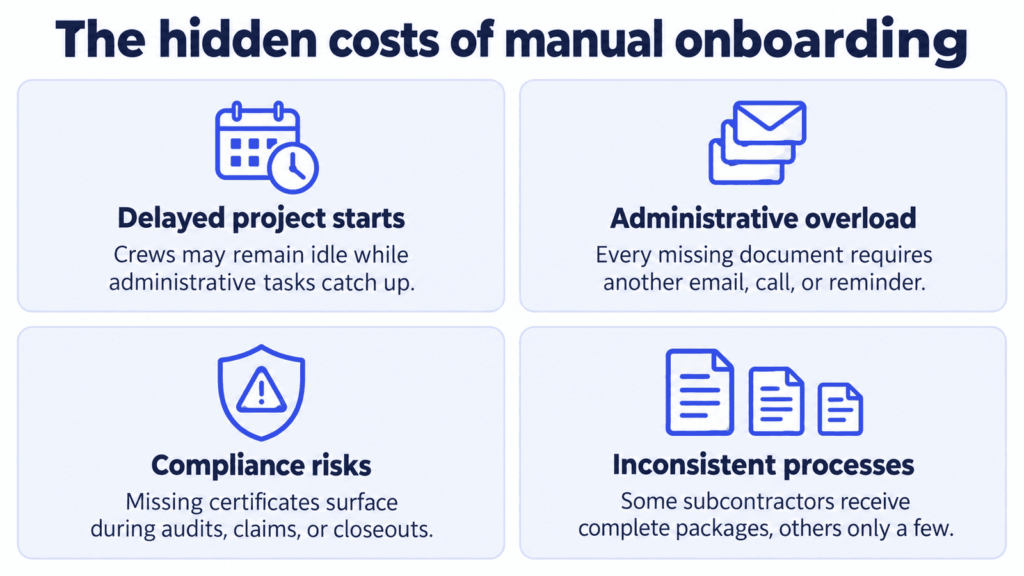
Delayed Project Starts
Projects can’t move forward until subcontractors are approved.
If onboarding documents are incomplete or waiting for signatures, crews may remain idle while administrative tasks catch up.
Even a short delay can affect project schedules, subcontractor coordination, and material deliveries.
Administrative Overload
Every missing document usually requires another email, phone call, or reminder.
Operations teams often spend hours:
- Requesting missing forms
- Tracking approvals
- Organizing files
- Confirming signatures
- Following up with subcontractors
As the number of active projects grows, so does the administrative workload.
Compliance Risks
Construction companies must maintain accurate records throughout every project.
Missing insurance certificates, unsigned agreements, or incomplete safety documentation can create unnecessary compliance risks during audits, claims, or project closeouts.
Without one centralized location for onboarding documents, finding the right record often becomes another manual task.
Inconsistent Processes
When every project manager follows a different onboarding process, documentation becomes inconsistent.
Some subcontractors receive complete onboarding packages.
Others receive only a few documents.
The result is confusion, duplicated work, and increased operational risk.
Why This Matters for Texas Contractors
Texas construction companies often coordinate dozens—or even hundreds—of subcontractors across multiple projects.
Whether supporting commercial developments in Dallas, industrial facilities in Houston, manufacturing projects in Austin, or infrastructure work across the state, contractor networks continue to grow alongside project demand.
That growth creates more vendor relationships to manage.
Without standardized onboarding workflows, construction teams spend more time handling paperwork and less time preparing projects for success.
For mid-market contractors, improving subcontractor onboarding is one of the most effective ways to scale operations without expanding administrative teams.
What a Digital Onboarding Workflow Looks Like
Modern onboarding workflows replace disconnected emails and paper forms with one centralized process.
A typical workflow might look like this:
| Manual Onboarding | Digital Onboarding |
| Email documents individually | Send complete onboarding package |
| Track responses manually | Monitor progress in real time |
| Print and scan agreements | Collect electronic signatures |
| Store files across folders | Centralized document management |
| Follow up by phone | Automated notifications and reminders |
Instead of wondering what’s missing, operations teams can immediately see which documents have been completed and which still require action.
Better Onboarding Creates Better Project Visibility
Subcontractor onboarding isn’t just about collecting paperwork.
It’s about giving project teams confidence that every contractor is ready to begin work.
With greater visibility, construction companies can:
- Track onboarding progress across multiple projects
- Verify completed documentation before mobilization
- Reduce duplicate requests for paperwork
- Maintain organized records for audits and project closeouts
- Improve collaboration between operations, procurement, and project teams
When everyone works from the same process, onboarding becomes faster, more consistent, and easier to manage.
How DottedSign Supports Subcontractor Onboarding
Construction projects generate a steady flow of vendor and subcontractor documentation.
From service agreements and safety acknowledgments to insurance forms and project-specific contracts, every document plays an important role in preparing teams for work.
DottedSign gives construction companies one centralized platform to:
- Send onboarding documents electronically
- Collect secure electronic signatures
- Track document completion in real time
- Create reusable onboarding templates
- Enable mobile signing from virtually anywhere
- Store completed records with secure audit trails
Instead of relying on scattered emails and manual follow-ups, project teams gain greater visibility into every stage of the onboarding process.
For contractors using procurement systems, vendor portals, or internal applications, DottedSign’s API can also embed electronic signatures directly into existing workflows, creating a more seamless onboarding experience.
Best Practices for Faster Subcontractor Onboarding
As contractor networks grow, consistency becomes increasingly important.
Consider these best practices:
✅ Create standardized onboarding packages
✅ Use reusable templates for recurring documents
✅ Enable mobile signing for subcontractors
✅ Store documents in one searchable location
✅ Track onboarding progress in real time
✅ Maintain secure audit trails for compliance
Improving onboarding doesn’t just reduce paperwork—it helps projects start faster and keeps operations organized as your business grows.
Frequently Asked Questions
Most construction companies collect service agreements, insurance certificates, W-9 forms, safety acknowledgments, compliance documents, work authorizations, and project-specific contracts before work begins.
Manual onboarding requires multiple emails, phone calls, printed documents, and manual tracking, increasing administrative work while delaying project readiness.
Yes. Digital document workflow platforms allow subcontractors to review and sign documents securely from smartphones, tablets, or computers, making it easier to complete onboarding without returning paperwork by hand.
Better Onboarding Helps Projects Start Faster
Every successful construction project begins long before crews arrive on-site.
When subcontractor onboarding is organized, consistent, and easy to complete, project teams spend less time chasing paperwork and more time preparing work to begin.
By replacing manual onboarding with digital document workflows, Texas contractors can reduce administrative bottlenecks, improve compliance, and create a smoother experience for both internal teams and subcontractors.
Because when onboarding moves faster, projects do too.
Ready to Modernize Your Subcontractor Onboarding Process?
DottedSign helps Texas construction companies route, approve, track, and manage subcontractor documentation from one centralized platform. Whether you’re collecting service agreements, safety acknowledgments, insurance forms, or project-specific contracts, digital workflows help simplify onboarding, improve visibility, and prepare every project for a stronger start.